About
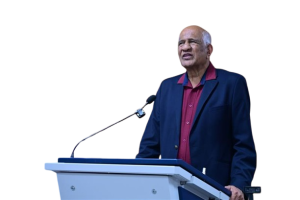
Justice Zakeria Mohammed Yacoob served as a Judge of the Constitutional Court of South Africa from 1998 to 2013, earning distinction as one of the Court’s most principled voices on equality, human dignity and social justice. Blind from childhood, he stands as a powerful testament to intellectual resilience and moral courage in the face of systemic injustice. Justice Yacoob played a direct role in shaping South Africa’s constitutional future. His judgments are especially noted for advancing socio-economic rights, substantive equality, disability justice and transformative constitutionalism. He is widely respected for his jurisprudential clarity, ethical depth and unwavering commitment to constitutional morality.
Justice Yacoob received his schooling at Arthur Blaxall School for the Blind in Durban from 1956 to 1966. He pursued higher education at the University College, Durban, completing his Bachelor of Arts from 1967 to 1969, followed by an LL.B. degree from the University of Durban-Westville from 1970 to 1972. He completed his pupillage in Durban in 1973 and was admitted as an advocate of the Natal Provincial Division of the Supreme Court of South Africa in 1973.
From 1973 to 1991, he practised as a junior counsel, developing a formidable reputation in human rights litigation, criminal defence, constitutional advocacy and commercial law. He was appointed Senior Counsel in 1991, in recognition of his standing at the Bar.
Throughout his legal career under apartheid, Justice Yacoob was at the forefront of legal resistance to unjust laws, representing:
- Individuals prosecuted for contravening security laws, emergency measures and other oppressive legislation.
- Victims of unfair evictions and discriminatory municipal tariffs.
- The “Durban Six” during negotiations with the British government after their occupation of the British Consulate in 1984.
- From 1985 to 1988, he was part of a team that defended officials and members of the United Democratic Front and its affiliates in the Delmas Treason Trial.
- In 1990 and 1991, he represented the accused in the ‘Vula’ trial, which involved high-ranking members of the African National Congress.
Justice Yacoob’s life exemplifies the profound convergence of legal practice and political resistance. He was the executive member of the Natal Indian Congress from 1981 to 1991. In that capacity, he organised and took part in protests and addressed many anti-apartheid mass meetings. As the executive member of the Durban Housing Action Committee from 1982 to 1985, he was involved in action aimed at ensuring that the Durban City Council managed its housing schemes fairly.
Justice Yacoob has been a lifelong advocate for disability inclusion and civic participation. He was the chairperson of the South African National Council for the Blind and was a member of its National Management Committee and its National Executive Committee from 2001 to 2009. He also served on the Council of the University of Durban-Westville during 1989 to 1993 and 1995 to 1997. He was the Chancellor of the University of Durban-Westville from 2001 to 2003.
Justice Yacoob’s legacy lies in the fact that constitutionalism is not secured by text alone but by the character of those entrusted to interpret it. His work affirms that the deepest authority of the law flows not from power, but from principled commitment to human dignity. His contributions to socio-economic rights, disability jurisprudence and substantive equality continue to structure how justice is understood in post-apartheid South Africa.